01
Product catalogue
Product structure and business rules
Wholesale & B2B commerce, Anonymised client delivery
Primewayz has contributed to the ongoing development and technical continuity of a business-critical wholesale order-management platform, supporting complex catalogue, inventory, customer, order and operational workflows.
Client identity, proprietary business rules and sensitive operational logic are withheld in line with client confidentiality directives. The full disclosure basis is explained later in this case study.
The operating context
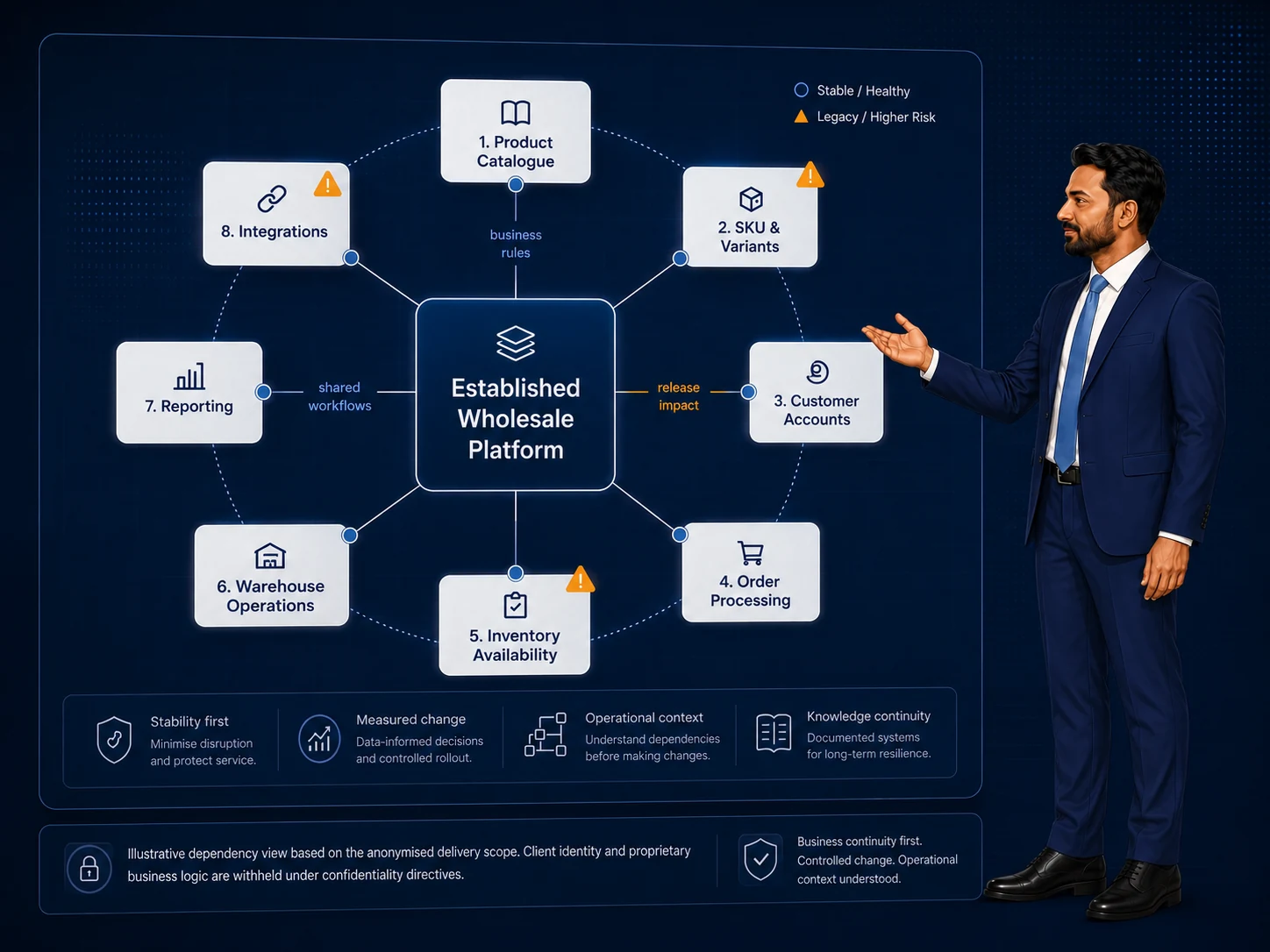
The work sat across a connected wholesale operation rather than one isolated feature. Catalogue, customer, stock, warehouse, order and integration workflows all influenced how change needed to be understood and released.
Connected operating model
A live application supporting daily operational processes through shared data, inherited rules and connected workflows.
Core wholesale platform
Business rules, shared data and release-sensitive workflows
Product structure and business rules
Variants, packs and product relationships
Customer-specific access and trading context
Order capture, validation and progression
Stock position and availability decisions
Operational fulfilment workflows
Shared operational and management visibility
Connected services and data exchange
Shared data
One change can alter downstream behaviour.
Shared workflows
Operational areas cannot be assessed in isolation.
Release sensitivity
Continuity depends on controlled impact review.
Why this mattered
A request that appeared small at interface level could influence business rules, data and operational behaviour elsewhere.
Business rules and workflows had evolved across several connected operational areas.
Delivery implication
A change that looked local could influence data, behaviour or users elsewhere in the platform.
The platform needed to keep supporting live business processes while improvements were introduced.
Delivery implication
Delivery had to protect day-to-day trading activity rather than pause it for a large replacement programme.
Delivery transitions created a need for structured documentation, handover and retained application context.
Delivery implication
Decisions and dependencies needed to become visible to the wider team, not remain with one contributor.
Evidence governance
Anonymised client delivery described from Primewayz delivery records and the implementation scope approved for public disclosure.
Visual provenance
Purpose-built explanatory illustrations; not client application screenshots.
Primewayz responsibility
Supporting an inherited business application required more than feature implementation. The responsibility included understanding how the platform worked, how the business used it and how change could be introduced safely.
Delivery boundary
Primewayz contributed to ongoing development and continuity. The page does not claim ownership of the client organisation, its complete technology estate or confidential business results.
Ongoing software-development contribution to a long-running business application.
Reviewing existing application behaviour before changing operational rules.
Supporting product, variant and catalogue processes within the established platform.
Supporting inventory, warehouse, customer and order workflows as connected areas.
Using technical analysis, prioritisation and focused implementation for safer change.
Retaining decisions, context and handover knowledge across delivery contributors.
Delivery approach
The practical objective was not to rewrite for its own sake. It was to understand the inherited system, protect continuity and introduce focused improvements safely.
Evidence-led delivery
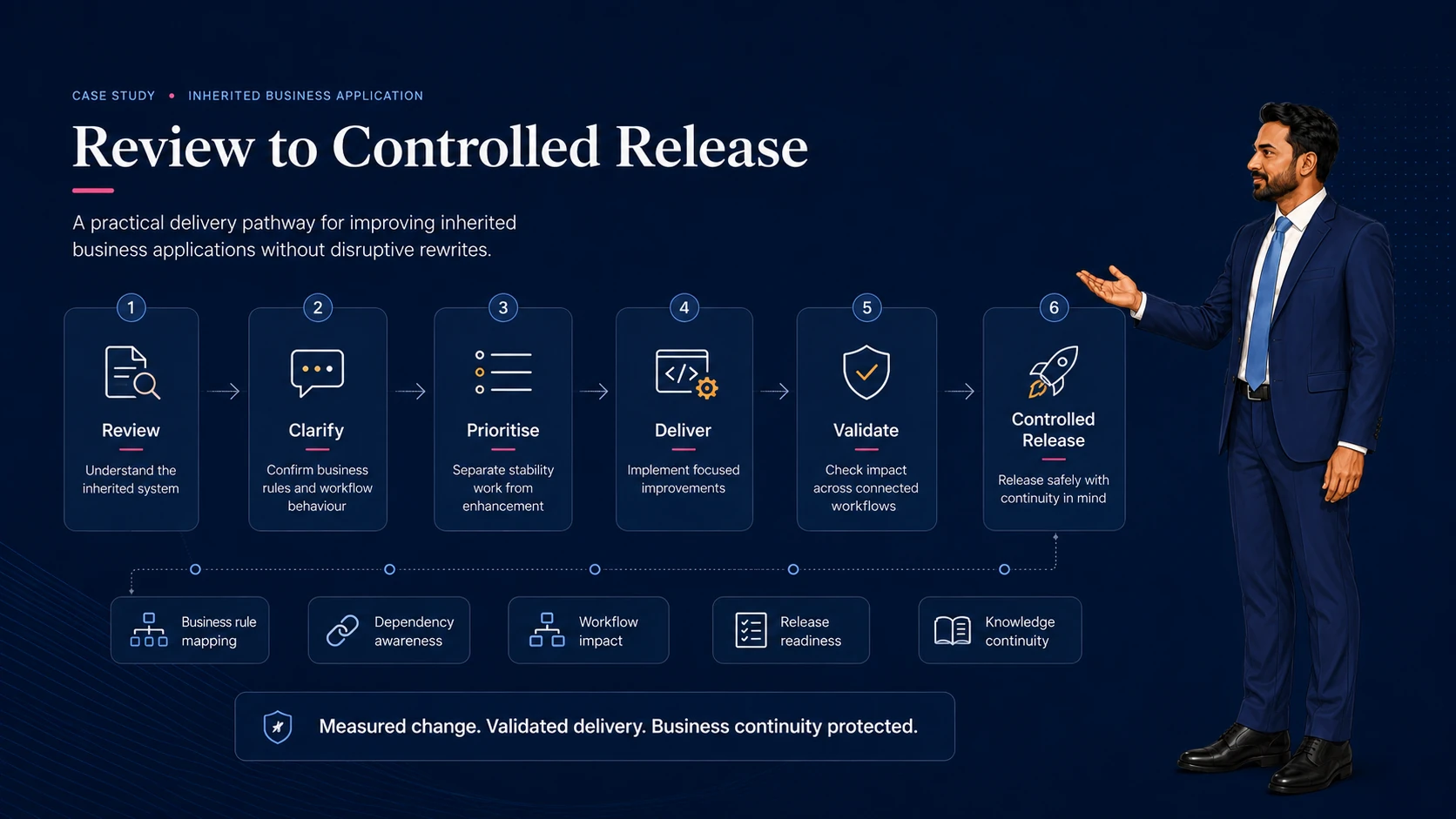
These practices helped the team understand dependencies, clarify requests, assess impact, prepare releases and retain application knowledge. The visuals are purpose-built illustrations, not client screenshots.
What this evidence demonstrates
Clarify before build
Understand the request and inherited behaviour first.
Trace impact
Review connected workflows before release.
Retain context
Record decisions so knowledge survives transition.
Delivery practice
01Connecting business rules to the workflows and system areas they influence.
Connects rules to affected workflows
Delivery practice
02Checking how a proposed change may affect catalogue, customers, stock, warehouse and orders.
Reveals downstream operational impact
Delivery practice
03Turning requests into understood, prioritised and testable delivery items.
Creates prioritised, testable delivery items
Delivery practice
04Reviewing scope, dependencies and validation needs before a controlled release.
Supports controlled release confidence
Delivery practice
05Recording decisions and reducing reliance on undocumented individual knowledge.
Reduces reliance on individual knowledge
Important delivery decisions
The delivery model was shaped by operational risk, inherited knowledge and the need to improve a live business application without unnecessary disruption.
Why: The platform was already supporting connected business processes.
Operational benefit: Improvements could be introduced without unnecessarily destabilising established operations.
Why: Inherited workflows may contain business rules that are not obvious from the interface or ticket alone.
Operational benefit: Implementation decisions could be aligned to intended business outcomes.
Why: Changes in one operational area could influence data, workflow or behaviour elsewhere.
Operational benefit: Smaller, reviewable releases reduced the breadth of uncontrolled change.
Why: Long-running applications become vulnerable when critical context exists only with individual contributors.
Operational benefit: Delivery transitions could retain more application and business knowledge.
Qualitative outcomes
These outcomes are deliberately qualitative. Primewayz is not publishing invented performance percentages, financial claims or confidential client measures.
A business-critical application remained actively supported through ongoing technical contribution.
Complex inherited workflows could be handled through a clearer delivery structure and retained context.
Improvement could continue without treating complete replacement as the automatic first step.
Transition and documentation created a stronger basis for ongoing support and future delivery.
Technical and operational scope
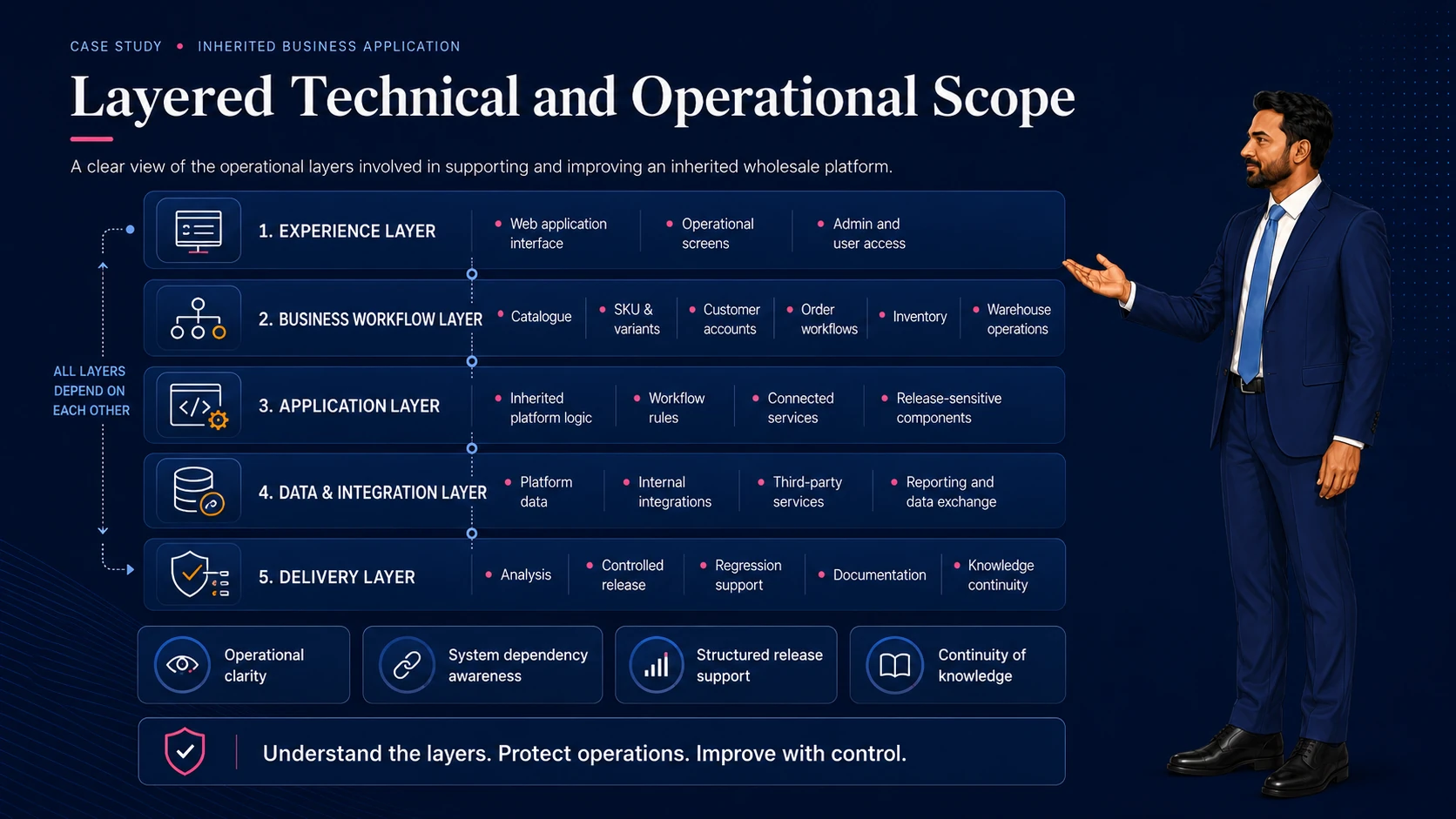
The platform was not only a user interface. Business workflows, application logic, data dependencies, integrations and delivery practices all influenced safe change.
Web application interface, operational screens and user access.
Catalogue, SKU, customer, order, inventory and warehouse workflows.
Inherited platform logic, workflow rules and release-sensitive components.
Platform data, internal integrations, third-party services and reporting exchange.
Analysis, controlled release, regression support, documentation and continuity.
Trust and confidentiality
Trustworthy case studies should separate verified delivery facts from information that cannot responsibly be disclosed.
The client identity, internal project references, proprietary business rules, sensitive operational logic, confidential screenshots and commercial measures are not published. The case study therefore describes the delivery approach and operational scope without exposing confidential client information.
Primewayz contributed to ongoing development, inherited-workflow understanding, controlled enhancement, release support and knowledge continuity across the operational scope described on this page.
Relevant services
The correct starting point depends on whether the immediate need is structured assessment, ongoing engineering capacity or continuity support.
Not sure which service fits?
Start with a Digital Systems Review. Primewayz will review the inherited application, current delivery risk and immediate operational priorities before recommending the next step.
Ongoing engineering capacity for a prioritised backlog, evolving workflows and regular controlled delivery.
Best when
Best when the application needs continued improvement rather than a one-off project.
Structured support for reliability, fixes, updates and carefully controlled improvements.
Best when
Best when continuity, responsiveness and ownership are the immediate priorities.
Additional developers, QA, analysis or technical capability integrated with the existing delivery team.
Best when
Best when internal capacity is constrained but the organisation wants to retain delivery direction.
Practical next step
Share the application, workflow or continuity issue creating friction. Primewayz will review the context and identify the most useful starting point without assuming a rewrite is the answer.