AI has made content creation easier than it has ever been. A small business can now generate LinkedIn posts, captions, blog drafts, image ideas, video scripts, newsletters, and a month of social prompts in one sitting.
That is useful. It can save time, reduce blank-page pressure, and help small teams show up more consistently. But many UK SMEs are now discovering a harder truth: output has multiplied faster than outcomes. More posts are going live, but visibility, trust, enquiries, and commercial movement are not always improving.
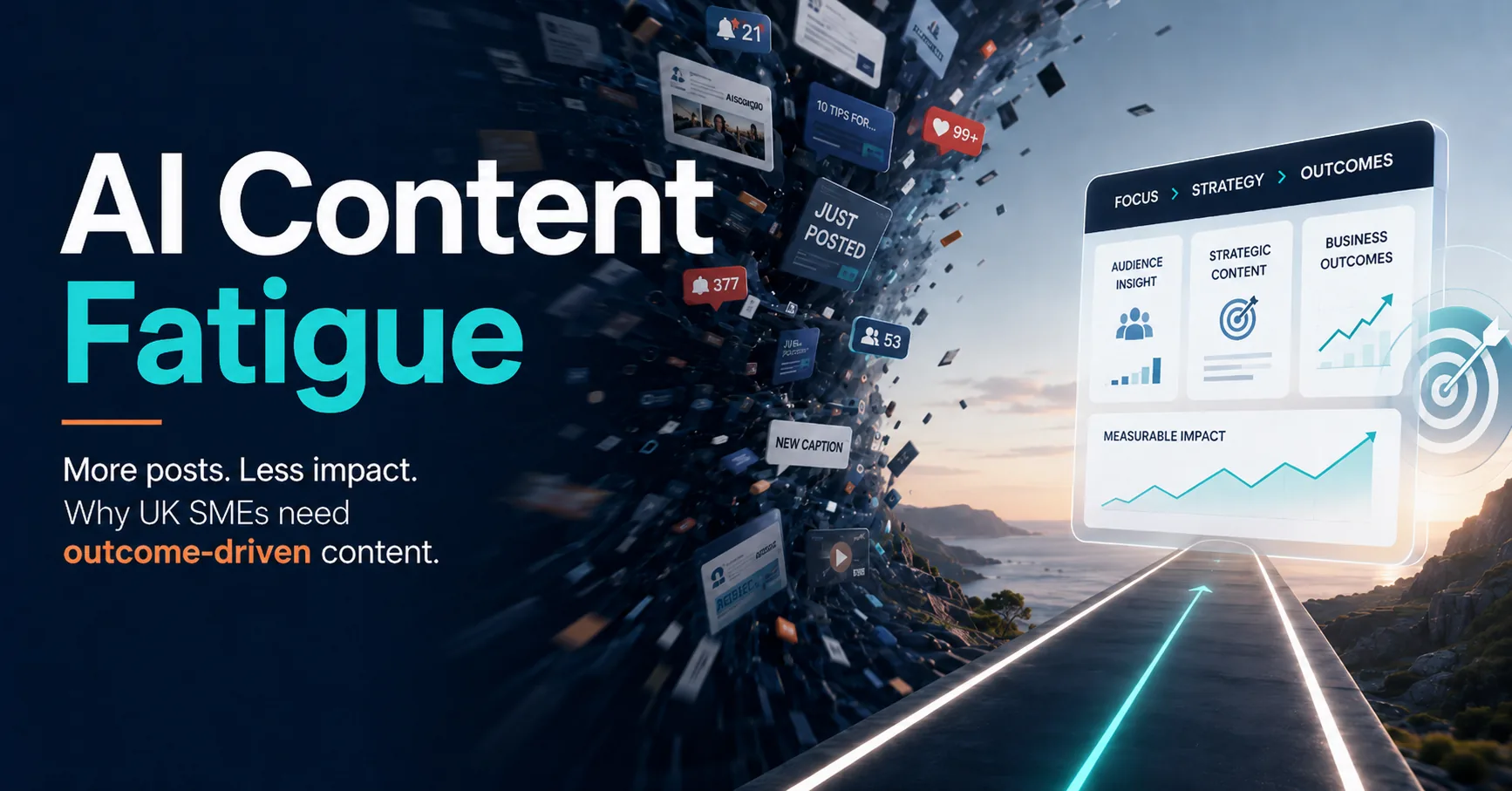
That gap is where AI content fatigue starts. AI content fatigue is the point where audiences become less responsive because they are seeing too much similar AI-assisted content with too little relevance, originality, lived experience, or buyer journey connection.
This is not an anti-AI argument. AI solved a real production problem. It did not solve attention, trust, positioning, distribution, conversion, or follow-up. For UK SMEs, SaaS founders, consultants, agencies, and professional service teams, the next advantage is not simply publishing more. It is building an outcome-driven visibility system.
AI solved the content production problem
For years, one of the biggest barriers to content was production capacity. Founders knew they needed to explain their services, publish useful articles, share ideas on LinkedIn, improve service pages, and keep newsletters moving. The difficulty was time.
AI changed that. It can help with ideation, first drafts, outlines, captions, scripts, FAQs, social calendars, email sequences, repurposing, and internal content briefs. It can turn one article into a LinkedIn post, a company page update, a short video script, a carousel outline, and a newsletter section. For small teams, that speed matters.
But production speed is no longer the main bottleneck. If every competitor can produce at speed, speed stops being the differentiator. The differentiator becomes judgement: what to say, who it is for, what belief it should build, where it should send the reader, and how the business will measure whether it helped.
What is AI content fatigue?
AI content fatigue is the audience and market response that happens when AI-assisted publishing creates more volume than value. People see more posts, more summaries, more frameworks, and more polished advice, but less real specificity. The content may be grammatically clean and technically useful, yet still feel interchangeable.
For UK SMEs, this often appears as a quiet pattern: the business posts more often, but profile visits do not rise; the website gets traffic, but service pages do not convert; likes appear, but enquiries do not improve; and the team cannot explain which content supports which business outcome.
The new problem: content congestion
Content congestion is the stage where businesses publish more because AI makes it easy, but the audience does not respond because the content lacks strategy, relevance, originality, or buyer journey connection.
It feels productive from inside the business. The calendar is full. The team is posting. The company page looks active. Blog drafts are moving. But from the outside, the audience may see another general post about growth, another generic list of tips, another AI-polished article, and another CTA that asks for a call before enough trust has been built.
More output. Same silence.
That silence is not always a content quality problem. Sometimes it is a system problem. Content is being created, but it is not connected to a clear audience, a website page, a trust signal, a useful offer, a CRM follow-up process, or a monthly improvement rhythm.
Why more content is not creating more outcomes
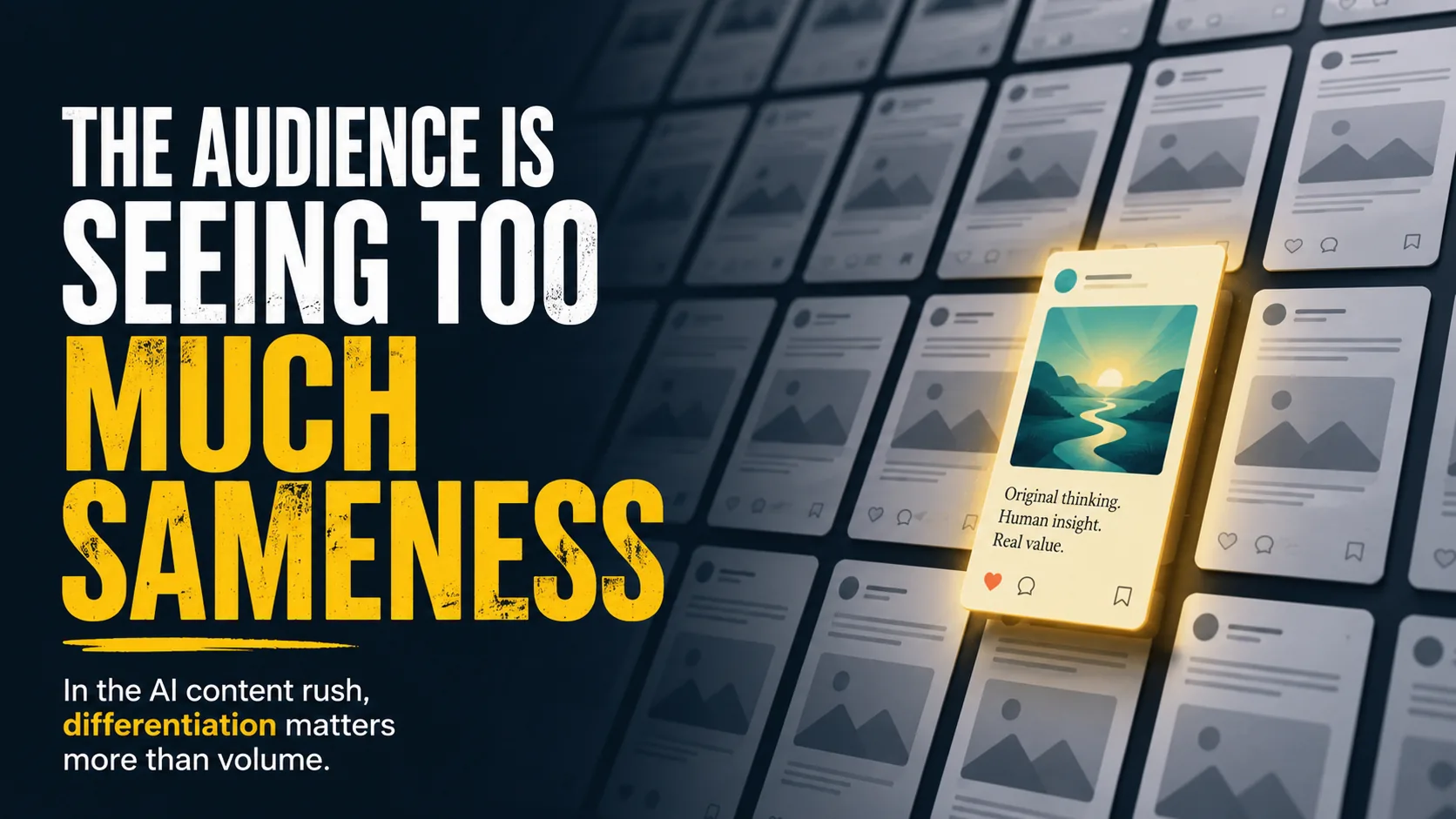
The audience is seeing too much sameness
AI-polished content often uses similar structures: a broad hook, a list of lessons, a short personal reflection, a framework, and a soft CTA. None of that is wrong. The problem is that many businesses use the same structures, the same tones, and the same safe advice.
When everything sounds useful in the same way, differentiation drops. A UK consultant may publish sensible posts about leadership, operations, AI, productivity, and growth, but if the posts could belong to almost any consultant, the market does not build a strong memory. The content creates activity, but not association.
AI-polished content often lacks lived experience
AI can help structure an idea, but it cannot automatically know what the last client struggled with. It does not know why a project got delayed, what prospects ask before buying, which objections appear in sales calls, which service pages get traffic but no enquiries, or what the team learned from delivery.
That lived experience is often the best content source. A founder who has seen three CRM projects fail for the same reason has a sharper article than a generic AI prompt can produce. A service team that knows exactly where enquiries go cold can write a more useful page than one built from broad keyword ideas alone.

Random topics weaken positioning
Many small businesses post whatever feels current: AI, leadership, hiring, productivity, founder life, marketing tips, customer service, tools, trends, and industry news. The content may be individually good, but collectively unclear.
Strong content repeatedly connects the business to one audience, one problem category, and one type of outcome. For Primewayz UK, that means digital visibility, service page clarity, CRM follow-up, SEO/AEO/GEO readiness, SaaS delivery support, and monthly improvement support for UK SMEs. The repetition is not boring when the angle stays useful. It is how the market learns what to remember you for.
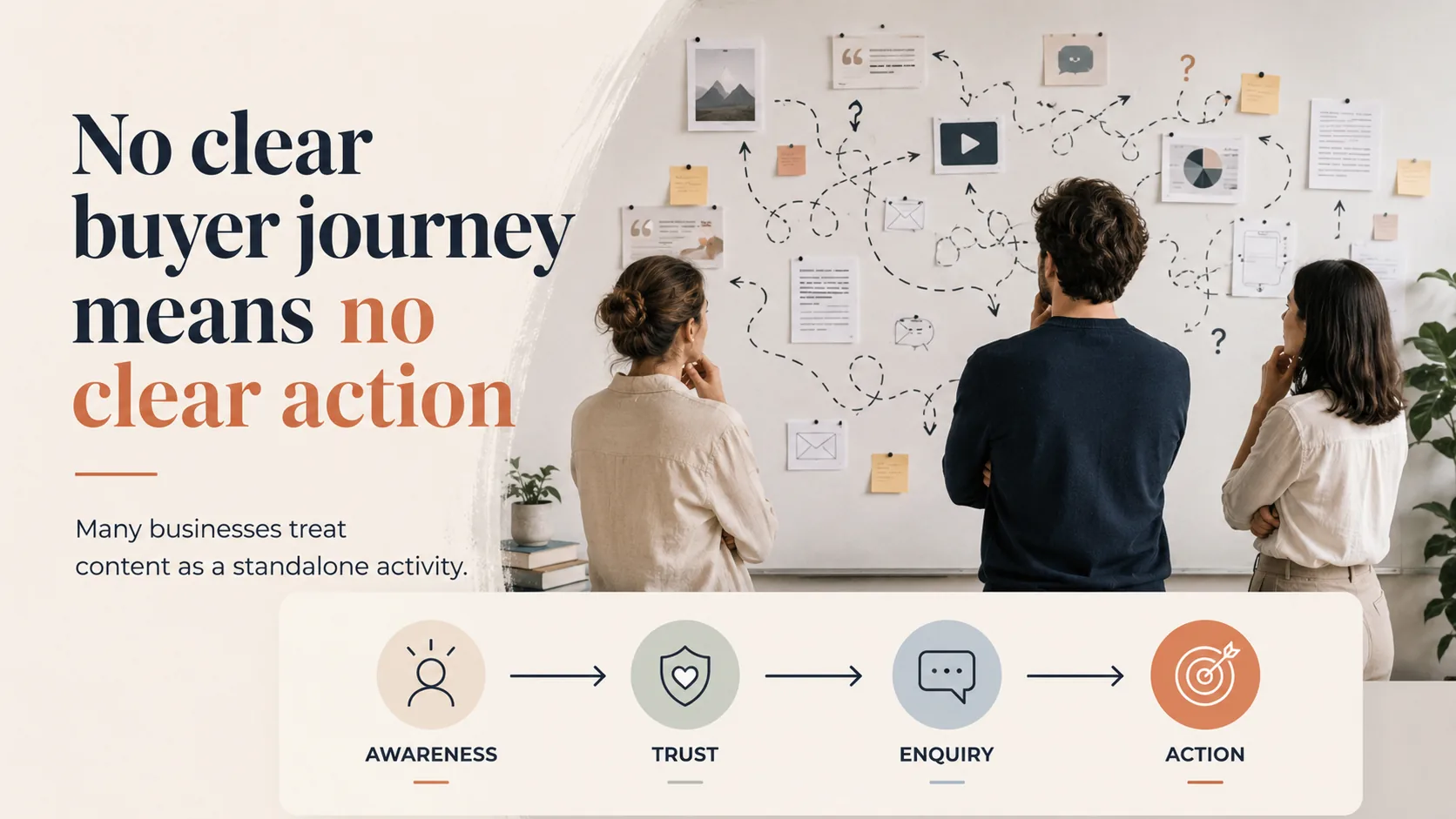
No clear buyer journey means no clear action
Content often gets treated as a standalone activity. A post is written, published, and then judged by likes or impressions. But a stronger system connects content to the full buyer journey:
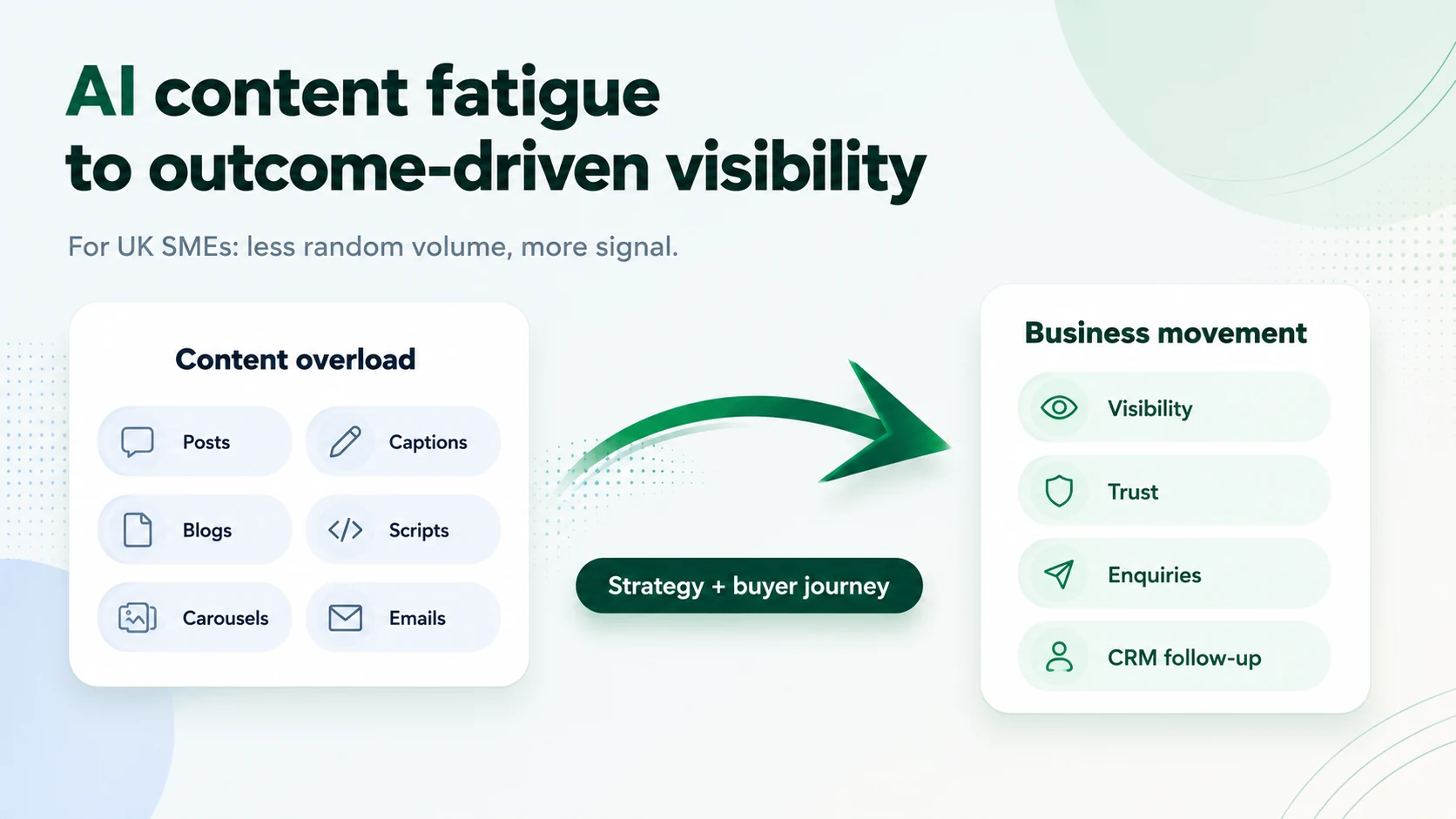
Post - Website page - Trust signal - Call to action - CRM follow-up - Monthly improvement.
For example, a LinkedIn post about poor enquiry flow should connect to a relevant page about CRM follow-up or a practical audit. A post about unclear service pages should connect to website visibility support. A SaaS founder article should support a page about software product delivery, not leave the reader with nowhere useful to go next.
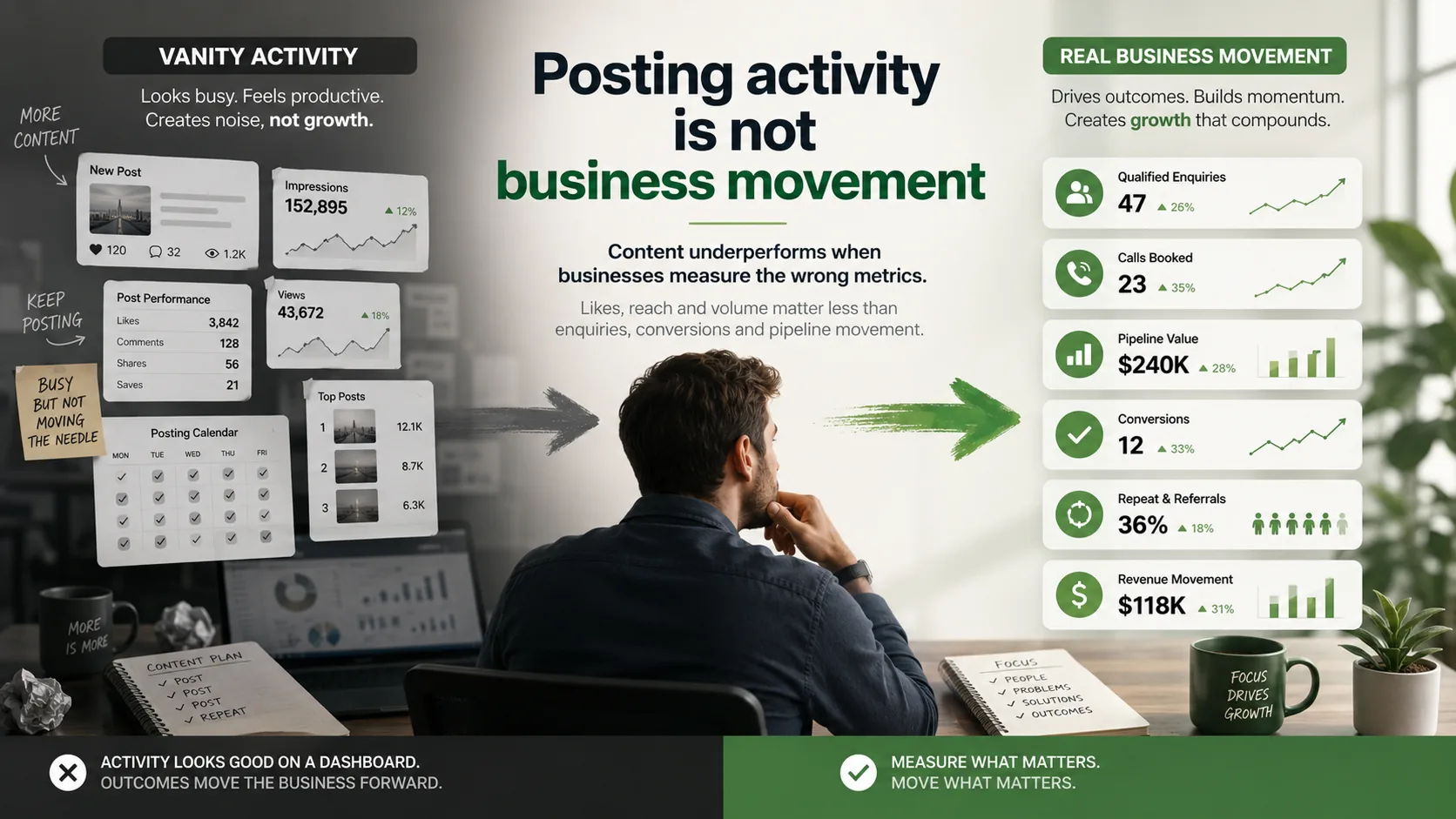
Metrics focus on posting activity, not business movement
Likes, views, reach, and post count are incomplete. They can help you understand distribution, but they do not prove commercial progress. A post with modest engagement may still send the right prospect to a service page. A high-reach post may create no movement at all.
UK SMEs should also track profile visits, website visits, service page clicks, audit starts, form submissions, booked calls, CRM leads, follow-up completion, and enquiry quality. That is where a free website visibility audit can be more useful than another content calendar review.
Primewayz UK helps UK SMEs review website visibility, content structure, SEO signals, enquiry flow, and digital support gaps.
Why does more AI content not create more outcomes?
More AI content does not automatically create more outcomes because business results depend on clarity, trust, relevance, distribution, conversion paths, and follow-up. AI can increase the number of drafts, but it does not automatically choose the right audience, own the right problem, improve the website journey, or make the enquiry process stronger.
Google's guidance on helpful, reliable, people-first content is a useful reminder here: content should be created for people first, not just to fill a publishing schedule. The SEO Starter Guide also reinforces that search visibility depends on useful, crawlable, well-structured pages, not volume alone.
The real bottleneck is no longer creation. It is direction.
Before asking AI for more posts, UK SMEs should ask stronger strategic questions:
- Who are we trying to reach?
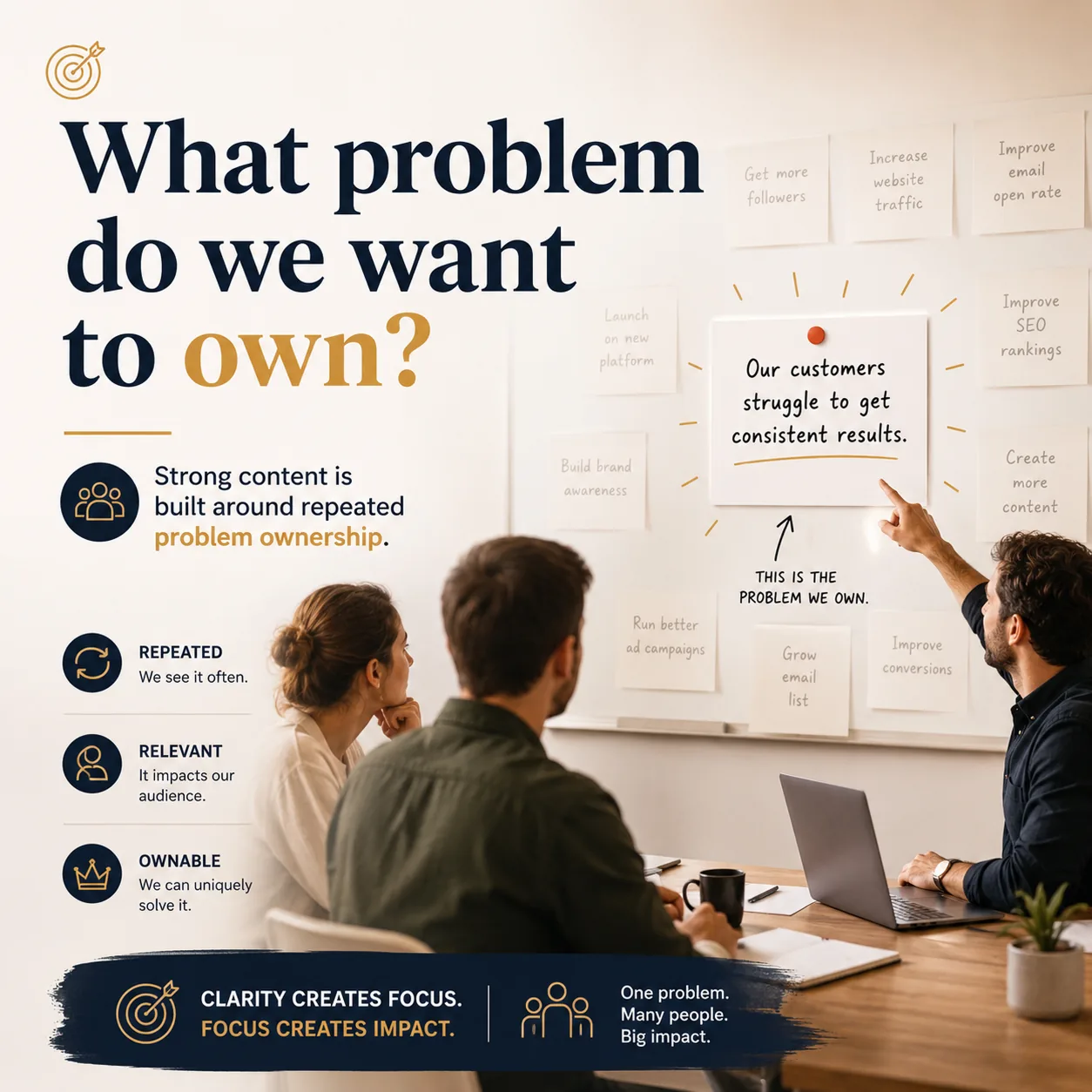
- What problem do we want to own?
- What belief are we trying to build?
- What should the reader do next?
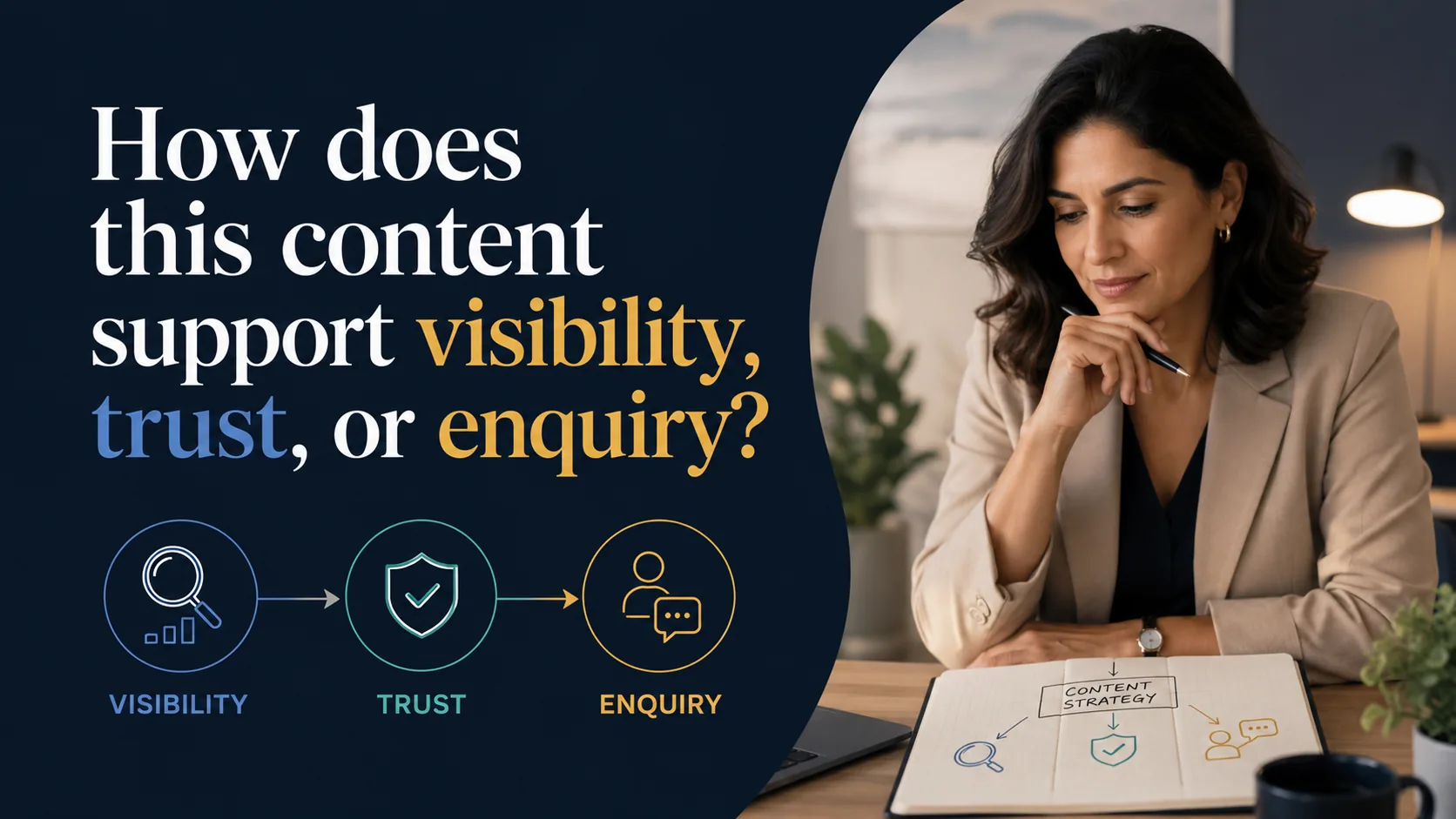
- How does this content support visibility, trust, or enquiry?
If those answers are unclear, AI will simply help the business publish uncertainty faster. The output may look polished, but the market will not know what to associate the business with.
How UK SMEs can keep content rapid but outcome-centric
Build around one audience
Choose a primary audience and write as if you understand their real operating pressure. Examples include UK SME founders, SaaS founders, consultants, service professionals, agencies, and professional service firms. A focused audience makes examples sharper and CTAs more relevant.
Own one clear problem category
A business does not need to talk about everything. It needs to become memorable for a meaningful problem. For Primewayz UK, useful problem categories include website visibility and trust, monthly digital support, CRM automation and follow-up, SEO/AEO/GEO readiness, SaaS delivery support, and outcome-driven content strategy.
Use content pillars, not random daily topics
Content pillars help small teams stay focused without becoming repetitive. A practical set for Primewayz UK would be visibility, conversion, automation, delivery models, and AI and digital strategy.
Each pillar should link back to useful pages and offers. Visibility content can support a digital visibility system. Automation content can support lead tracking workflows. Delivery model content can support SaaS and product delivery support.
Connect posts to useful website pages
A social post should not be the end of the journey. It should point to a helpful service page, blog article, audit, checklist, or next step. That is how content becomes part of a website visibility system instead of a loose collection of updates.
For example, a post about content fatigue can point to the UK SME digital visibility checker. A post about lost enquiries can point to CRM automation support. A post about technical upkeep can point to ongoing website support. Readers get a useful next step, and the business can measure movement.
Repurpose with intent, not repetition
Repurposing should not mean copying the same idea everywhere. One article can become LinkedIn posts, company page updates, images, short videos, pinned comments, FAQs, newsletter sections, and service page support copy. But each version should have a clear role.
A founder post can build belief. A company page post can invite audit starts. A short video can explain the problem. A FAQ can support answer engines. A service page section can improve conversion. Repurposing works best when every format has a job.
Measure business movement, not only content volume
A simple measurement model is enough for most UK SMEs:
- Visibility: impressions, profile visits, search visibility, article visits.
- Trust: service page engagement, case study views, about page visits, proof-point clicks.
- Enquiry: audit starts, form submissions, booked calls, CRM leads, response time.
- Improvement: monthly changes completed, weak pages improved, follow-up gaps reduced.
How can UK SMEs make content outcome-driven?
UK SMEs can make content outcome-driven by starting with the business movement they want, then planning backwards. If the goal is better visibility, the content should support searchable topics, stronger service pages, and technical SEO foundations. If the goal is more enquiries, the content should send readers to clear CTAs, relevant pages, and reliable forms. If the goal is better sales follow-up, the content should connect to CRM workflows and team ownership.
This is where SEO, AEO, and GEO visibility need to work together. SEO helps pages become discoverable in search. AEO helps content answer specific questions clearly. GEO readiness helps content become easier for AI answer engines and search experiences to understand, cite, and summarise. Microsoft Bing's Webmaster Guidelines are another useful reminder that quality, relevance, discoverability, and trustworthy site behaviour still matter.
What comes after AI content fatigue?
The next phase of content will reward businesses that combine AI-assisted speed with human-led clarity. Human voice becomes more valuable because audiences want a sense of judgement, not only information. Original experience becomes a differentiator because it carries detail that generic content cannot fake. Trust signals matter more because people need evidence before they act.
Content will also be judged by usefulness and emotional relevance. A technically correct post may still fail if it does not meet the reader's real situation. AI may become better at emotional and contextual targeting, but small businesses should use that responsibly and ethically, not manipulatively. The goal is to help people understand their problem and take a sensible next step.
The Primewayz UK view: less noise, more signal
Primewayz UK helps UK SMEs build digital visibility systems, not just isolated content. That includes website visibility, SEO/AEO/GEO readiness, service page clarity, landing pages, analytics, CRM follow-up, conversion paths, and monthly improvement support.
For a small team, the advantage is not publishing ten more AI-assisted posts every week. It is knowing which content supports which page, which page supports which enquiry, which enquiry enters which workflow, and which monthly improvements make the system better.
For more related thinking, explore Primewayz UK insights on monthly digital support, foundation sprints, delivery models, and the UK SME digital adoption roadmap.
Frequently asked questions
What is AI content fatigue?
AI content fatigue is the drop in attention, trust, and response that happens when audiences see too much similar AI-assisted content without enough relevance, originality, lived experience, or clear next action.
Why does AI-generated content often underperform?
AI-generated content often underperforms when it is published without a clear audience, problem category, buyer journey, distribution plan, trust signal, or conversion path. The issue is usually direction, not the use of AI itself.
How can UK SMEs avoid content fatigue?
UK SMEs can avoid content fatigue by focusing content on one audience, one repeated problem category, useful website pages, real client experience, CRM follow-up, and business movement metrics rather than post volume alone.
Should small businesses stop using AI for content?
No. Small businesses should keep using AI where it helps with drafts, outlines, repurposing, and speed. The important step is adding human judgement, customer insight, delivery experience, and measurable outcomes before publishing.
What should businesses measure instead of post volume?
Businesses should measure profile visits, website visits, service page clicks, audit starts, form submissions, booked calls, CRM leads, follow-up completion, and enquiry quality alongside reach and engagement.
Final thought
AI made content faster. It did not make attention easier.
The businesses that win will be the ones that combine AI-assisted speed with human-led strategy, clarity, and trust.
Primewayz UK supports UK SMEs with website visibility, SEO/AEO/GEO readiness, CRM automation, landing pages, analytics, and monthly digital improvement support.